

Loading profile. Please wait . . .
Spiraea latifolia (Ait.) Borkh.
Broadleaf White Spirea


Federal Protection: No US federal protection
State Protection: No Georgia state protection
Global Rank: G5T5
State Rank: S1
Element Locations Tracked in Biotics: Yes
SWAP 2015 Species of Greatest Conservation Need (SGCN): Yes
SWAP 2025 Species of Greatest Conservation Need (SGCN): No
2025 SGCN Priority Tier:
Element Occurrences (EOs) in Georgia: 5
Habitat Summary for element in Georgia: Mountain bogs; roadside seeps
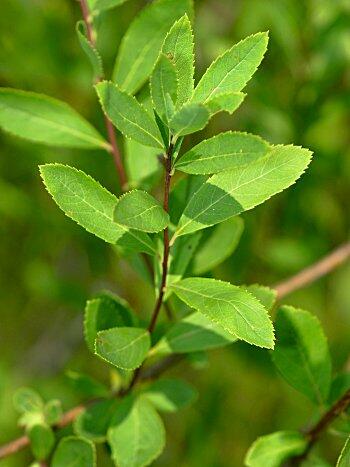
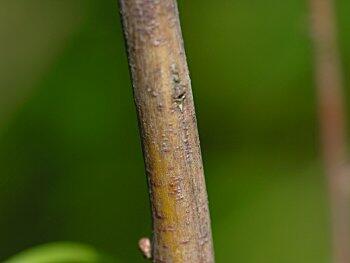
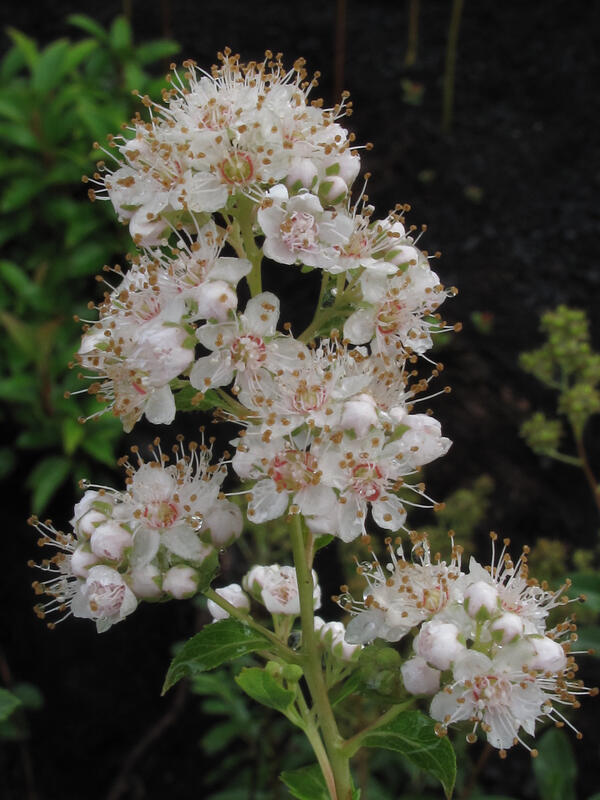
Shrub 3 - 6.5 feet (10–20 dm) tall. Stems erect, unbranched, hairless, reddish- to purplish-brown. Leaves 0.8 - 3 inches (2 - 8 cm) long and 0.4 - 1.2 inches (1 - 3 cm) wide, 2 - 3 times as long as wide, alternate, mostly hairless, broadly oval to lance-shaped with pointed tips and rounded or wedge-shaped bases; margins coarsely toothed; leaf stalks very short (2 - 4 mm). Flower clusters 2 - 8 inches (5 - 20) tall and 1 - 4 inches (3 - 10 cm) wide, held at the tips of branches, open and pyramid-shaped, composed of several small, rounded clusters of flowers; branches within the inflorescence are hairless. Flowers are small, about 0.25 inch wide (7 - 10 mm wide), with 5 white (rarely pink) rounded petals, 5 pistils, and 30 - 35 stamens that are tipped with pink anthers and conspicuously longer than the petals; a ring of pink or orange nectaries surround the base of the pistils; all parts of the flower are hairless. Fruits are small (3 - 4 mm), dry, shiny capsules, held in dense clusters.
Broadleaf White Spirea (Spiraea latifolia, synonym Spiraea alba var. latifolia) is very similar to Narrowleaf Meadowsweet (Spiraea alba), and they are considered by some botanists to be varieities of the same species. Narrowleaf Meadowsweet has narrower leaves (3 - 8 times as long as wide) that are finely toothed; its inflorescences and flowers are hairy; and its twigs are yellow-brown to brown. Narrowleaf Meadowsweet has not been seen in Georgia, though it occurs in similar habitats in nearby areas of North Carolina, where it is considered rare.
Hardhack, Steeplebush (Spiraea tomentosa, Georgia Special Concern) has pink to rose-purple flowers in tight, narrow, erect clusters; the lower surfaces of its leaves are densely covered with tan, woolly hairs. It was known in Georgia from a single bog in Union County but has not been seen since 1930.
Virginia Spiraea (Spiraea virginiana, Threatened) occurs on flood-scoured riverbanks in shrub thickets. Its leaves are rounded and 2 - 4 times as long as wide, and its inflorescence is a flat-topped or rounded cluster, wider than long. (It is federally listed as endangered; see the species profile on this website).
Two exotic species of Spiraea have escaped from cultivation and are found in natural and semi-natural areas in Georgia:
1. Japanese Spiraea (Spiraea japonica) has pink flowers and leaves with hairy veins on the lower surfaces; it is a common roadside weed that invades natural areas. It is listed by the Georgia Exotic Pest Plant Council as a Category 2 Invasive: “Exotic plant that is a moderate problem in Georgia's natural areas through invading native plant communities and displacing native species.”
2. Bridal-wreath Spiraea (Spiraea prunifolia) is native to China, Korea, and Taiwan. Its inflorescence is a flat-topped cluster. Although it escapes from cultivation, it is not yet known to threaten natural areas.
Virginia Spiraea (Spiraea virginiana), state and federally listed as Threatened and considered critically imperiled in Georgia, occurs on flood-scoured riverbanks in shrub thickets. Its leaves are rounded and 2 - 4 times as long as wide, and its inflorescence is a flat-topped or rounded cluster, wider than long. It is federally listed as endangered; see the species profile on this website.
Hardhack, Steeplebush (Spiraea tomentosa), considered critically imperiled in Georgia, has pink to rose-purple flowers in tight, narrow, erect clusters; the lower surfaces of its leaves are densely covered with tan, woolly hairs. It was known in Georgia from a single bog in Union County but has not been seen since 1930.
Broadleaf White Spirea occurs range-wide in bogs, seeps, and rock outcrops (glades) over amphibolite, greenstone, olivine, and granite. In Georgia, it is known from mountain bogs and roadside seeps.
Broadleaf White Spirea is a medium-sized, deciduous shrub. Its flowers produce both nectar and pollen and are visited by a wide array of insects: bees, wasps, long-horned beetles, moths, and butterflies. Flowers within a cluster open from the top down, with the functionally male flowers at the top opening before the functionally female flowers at the bottom of the cluster, thus minimizing self-pollination. The primary pollinators – bees – visit the lowest flowers in a cluster first and then work up the spike to the top flowers. Once they reach the top, they move on to the bottom of clusters on another plant, thus carrying out cross-pollination. Broadleaf White Spirea flowers and buds are larval food for the caterpillars of Spring Azure butterflies. A number of moth larvae feed on the leaves. The fruits are eaten, and their seeds dispersed, by birds. The seeds are also dispersed by wind and water.
Surveys are best conducted during flowering, June–September, but leaf and bark characteristics can be diagnostic at other times in the growing season. The seed clusters persist through the winter and, with bark characteristics, can be used to identify this species.
Broadleaf White Spirea occurs from Georgia north to Michigan, Ontario, and Labrador.
Mountain bogs are one of the most endangered plant communities in the Southern Appalachians–they have been ditched, drained, and converted to agricultural and other forms of development. They have also been subject to fire suppression, which has led to encroachment by trees that compete with shrubs and ground cover species for light, water, and nutrients. Bogs are also threatened by feral hogs which root up plants and alter hydrology within the bogs. Bogs also receive polluted runoff from surrounding land uses. Roadside seeps are subject to roadside maintenance practices, such as mowing and herbicide spraying, and to road widening. Changes in hydrology due to altered temperature and rainfall patterns related to climate change are likely to negatively effect mountain bogs.
Broadleaf White Spirea is ranked S1 by the Georgia Department of Natural Resources, indicating that it is critically imperiled in Georgia. Four populations have been documented over the last half-century; three of these occur on U.S. Forest Service land.
Avoid ditching and draining of mountain wetlands. Prevent polluted runoff into sites. Hand-fell or use occasional fire to reduce tree competition. Eradicate feral hogs. Coordinate with county and state transportation departments to prevent impacts to roadside populations.
GADNR. 2019. Element occurrence records for Spiraea latifolia. Georgia Department of Natural Resources, Wildlife Resources Division. Social Circle, Georgia.
Hall, J.V., R.A. Murray, and L.P. Jackson. The biology of Canadian weeds: 2. Spiraea latifolia. https://www.nrcresearchpress.com/doi/pdf/10.4141/cjps74-023
Hilty, J. 2019. Species account for Meadowsweet, Spiraea alba. Illinois Wildflowers. Accessed 24 June 2019. https://www.illinoiswildflowers.info/wetland/plants/meadowsweet.htm
Lis, R. 2015. Species account for Spiraea alba var. latifolia. Flora of North America North of Mexico, vol. 26. Accessed 24 June 2019. http://www.efloras.org/florataxon.aspx?flora_id=1&taxon_id=250065730
NatureServe. 2019. Spiraea alba var. latifolia comprehensive report. NatureServe Explorer: an online encyclopedia of life, Version 7.1. NatureServe, Arlington, Virginia. Accessed 24 June 2019. https://explorer.natureserve.org/Taxon/ELEMENT_GLOBAL.2.129830/Spiraea_alba_var_latifolia
Weakley, A.S. 2015. Flora of the southern and mid-Atlantic States. University of North Carolina Herbarium, University of North Carolina, Chapel Hill. http://www.herbarium.unc.edu/flora.htm
Linda G. Chafin
24 June 2019