

Loading profile. Please wait . . .
Panax quinquefolius L.
American Ginseng


Federal Protection: No US federal protection
State Protection: No Georgia state protection
Global Rank: G3G4
State Rank: S3
Element Locations Tracked in Biotics: Yes
SWAP 2015 Species of Greatest Conservation Need (SGCN): Yes
SWAP 2025 Species of Greatest Conservation Need (SGCN): Yes
2025 SGCN Priority Tier: Moderate Conservation Concern
Element Occurrences (EOs) in Georgia: 157
Habitat Summary for element in Georgia: Mesic hardwood forests; cove hardwood forests
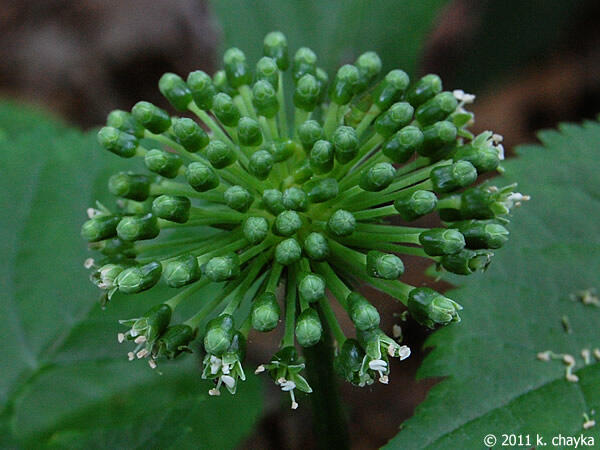
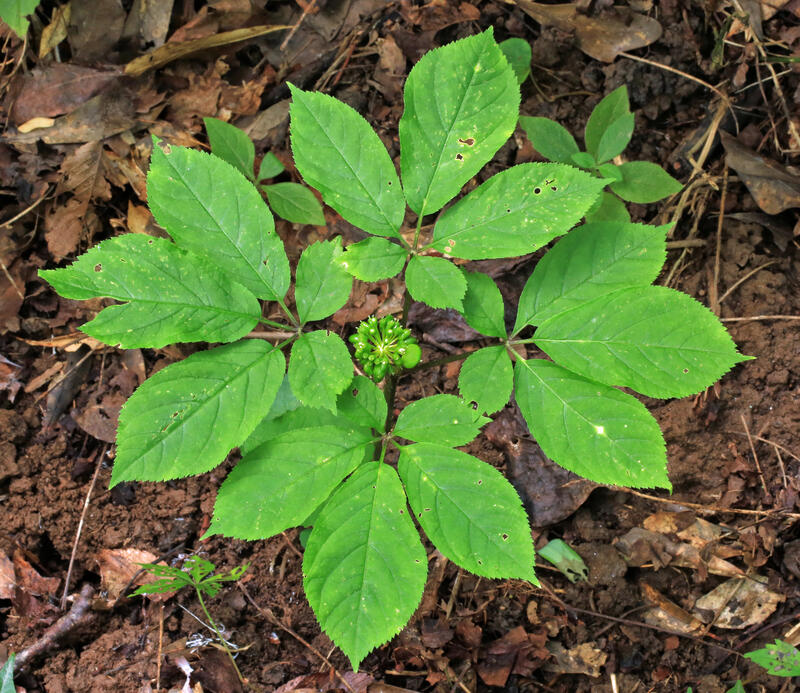
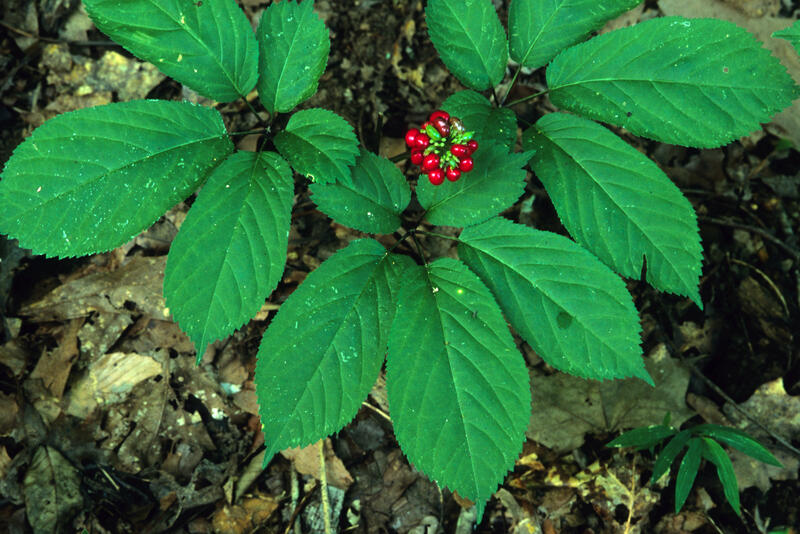
Perennial herb with a single, hairless, unbranched stem 0.7 - 2 feet (20 - 60 cm) tall rising from a fleshy, elongated, often branched root. The stem is topped with a whorl of palmately compound leaves, each with 3 - 5 leaflets and a leaf stalk 2 - 5 inches (5 - 13 cm) long. The leaflets are up to 6 inches long and 2.75 inches wide (6 - 15 cm long and 3.5 - 7 cm wide), the lower 2 leaflets smaller than the upper 3; each leaflet is hairless, oval to elliptic, with a pointed tip, toothed margins, and stalks less than 1 inch (2.5 cm) long. A single, spherical flower cluster is held at the tip of an erect stalk 1 - 10 inches (2 - 25 cm) tall that rises from the top of the stem, each cluster with 10 - 20 tiny, white or pale green, 5-petaled flowers. The fruits are round, bright red, pea-size berries containing 1 - 3 seeds.
Ginseng leaves superficially resemble those of Virginia Creeper (Parthenocissus quinquefolius), a woody vine with 5 palmately arranged leaflets. Virginia Creeper leaflets are attached directly to the top of the leaf stalk, i.e. the leaflets do not have stalks. Ginseng plants are herbaceous and the leaflets have stalks up to 1 inch (2.5 cm) long.
The palmately compound leaves of Ginseng plants also resemble those of Buckeyes (Aesculus spp.). Buckeye is a woody plant and its 5 leaflets are more or less all the same size, unlike Ginseng, where the lower two leaflets are smaller than the upper three.
Ginseng flower clusters resemble those of another species in the Aralia Family, Wild Sarsaparilla (Aralia nudicaulis), but Wild Sarsaparilla leaves are pinnately compound rather than palmately compound.
Dwarf Ginseng (Panax trifolius) occurs in rich, moist, hardwood forests in Georgia’s Blue Ridge Mountains. For more information, see: https://www.georgiabiodiversity.org/portal/profile?group=plants&es_id=16616
Rich hardwood forests in coves and ravines and moist streamside flats.
Ginseng is a long-lived, perennial herb that reproduces only by seed; it does not form clonal colonies. Its seeds germinate in the early spring 1.5 - 2 years after the seeds have dropped. During the first growing season, the plant consists of an inch-long root and a single leaf with 2 or 3 leaflets. Each subsequent year, the plant produces a stem in April, adding a leaf each year, up to 5. Mature plants live for many years, producing 5 leaves each year. Each leaf is called a “prong” and a mature plant is called a “five-pronger.” Ginseng begins to flower at year 4 or 5 in early to mid-summer; the bisexual flowers are pollinated by sweat bees and hover-flies. Fruits appear in July and mature in late summer and early fall. The fruits may be eaten by small animals.
Ginseng is most conspicuous when in flower or fruit, from June–October.
Georgia west to Louisiana, north to South Dakota, Maine, Ontario, and Quebec. It is rare or imperiled throughout its range.
The primary threat to Ginseng is over-harvesting by collectors for medicinal herb markets. It is also threatened by logging and habitat conversion to residential development and pastures.
| Threat 1 | Threat 2 | Threat 3 | |
|---|---|---|---|
| General Threat | Residential & commercial development | Biological resource use | Natural system modifications |
| Specific Threat | None | None | None |
Panax quinquefolius is ranked S3 by the Georgia Department of Natural Resources, indicating that it is “vulnerable in the state due to restricted range, relatively few populations, recent and widespread declines, or other factors making it vulnerable to extirpation.” More than 100 populations have been documented over the last half-century but the current status of most of these is unknown.
Harvesting of Ginseng in Georgia is regulated at both the state and federal level. The links below detail these regulations as well as approved harvesting methods:
https://www.fs.usda.gov/detailfull/conf/home/?cid=STELPRDB5429096&width=full
https://georgiawildlife.com/ginsengprogram
https://georgiawildlife.com/sites/default/files/wrd/pdf/OCGA/OCGATitle12_Chapter6_Article2_GinsengProtection_8-28-2013.pdf
Enforce plant poaching laws and regulations. Avoid logging, road building, and off-road vehicle use in rich hardwood forest coves and ravines.
Cruse-Sanders, J.M. and J.L. Hamrick. 2004. Genetic diversity in harvested and protected populations of wild American ginseng, Panax quinquefolius L. (Araliaceae). American Journal of Botany 91(4): 540-548.
Cruse-Sanders, J.M. and J.L. Hamrick. 2004. Spatial and genetic structure within populations of wild American Ginseng (Panax quinquefolius L., Araliaceae). Journal of Heredity 95(4): 309–321.
GADNR. 2019. Element occurrence records for Panax quinquefolius. Georgia Department of Natural Resources, Wildlife Resources Division. Social Circle, Georgia.
GADNR. 2015. Georgia Ginseng Management Program. Georgia Department of Natural Resources, Wildlife Resources Division. Social Circle, Georgia. https://georgiawildlife.com/ginsengprogram
Georgia Code. 2012. Title 12 – Conservation and natural resources, Chapter 6. Forest resources and other plant life. Article 2, Ginseng protection. https://georgiawildlife.com/sites/default/files/wrd/pdf/OCGA/OCGATitle12_Chapter6_Article2_GinsengProtection_8-28-2013.pdf
Mooney, E.H. and J.B. 2007. Effects of self-pollination and outcrossing with cultivated plants in small natural populations of American Ginseng, Panax quinquefolius (Araliaceae). American Journal of Botany 94(10): 1677-1687. https://bsapubs.onlinelibrary.wiley.com/doi/pdf/10.3732/ajb.94.10.1677
NatureServe. 2019. Species account for Panax quinquefolius. NatureServe Explorer: an online encyclopedia of life, Version 7.1. NatureServe, Arlington, Virginia. https://explorer.natureserve.org/Taxon/ELEMENT_GLOBAL.2.130734/Panax_quinquefolius
Penskar, M.R. and P.J. Higman. 1996. Special plant abstract for Panax quinquefolius (Ginseng). Michigan Natural Features Inventory, Lansing, MI. https://mnfi.anr.msu.edu › abstracts › botany › Panax_quinquefolius
Schlessman, M.A. 1985. Floral biology of American Ginseng (Panax quinquefolium). Bulletin of the Torrey Botanical Club 112: 129-133. https://www.jstor.org/stable/2996409?seq=1#metadata_info_ tab_contents
Weakley, A.S. 2015. Flora of the southern and mid-Atlantic States. University of North Carolina Herbarium, University of North Carolina, Chapel Hill. http://www.herbarium.unc.edu/flora.htm
Linda G. Chafin
Linda G. Chafin, 18 November 2019: original account