

Loading profile. Please wait . . .
Aralia nudicaulis L.
Wild Sarsaparilla


Federal Protection: No US federal protection
State Protection: No Georgia state protection
Global Rank: G5
State Rank: S2?
Element Locations Tracked in Biotics: Yes
SWAP 2015 Species of Greatest Conservation Need (SGCN): No
SWAP 2025 Species of Greatest Conservation Need (SGCN): No
2025 SGCN Priority Tier:
Element Occurrences (EOs) in Georgia: 17
Habitat Summary for element in Georgia: Northern hardwood forests
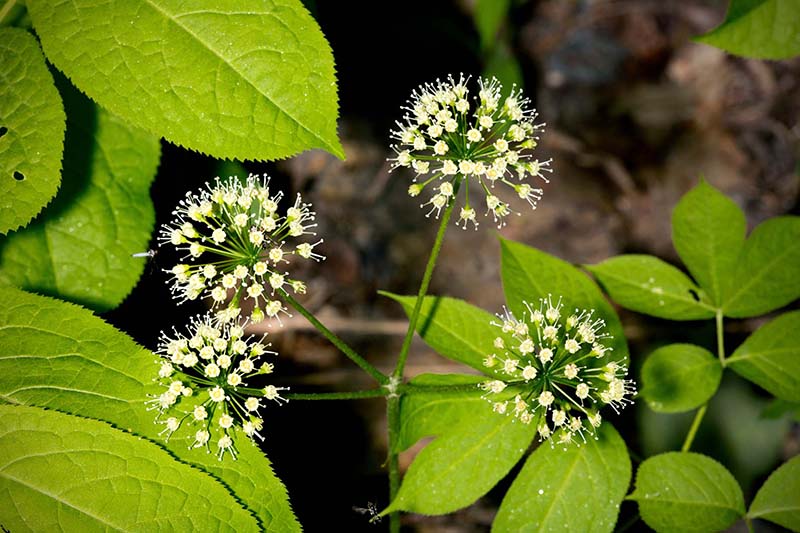
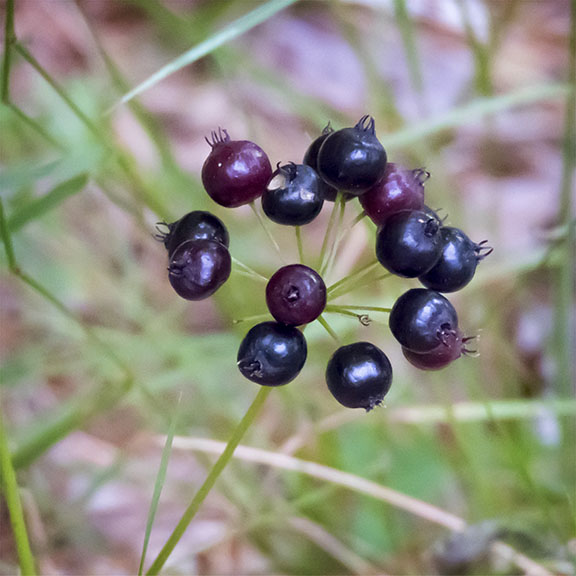
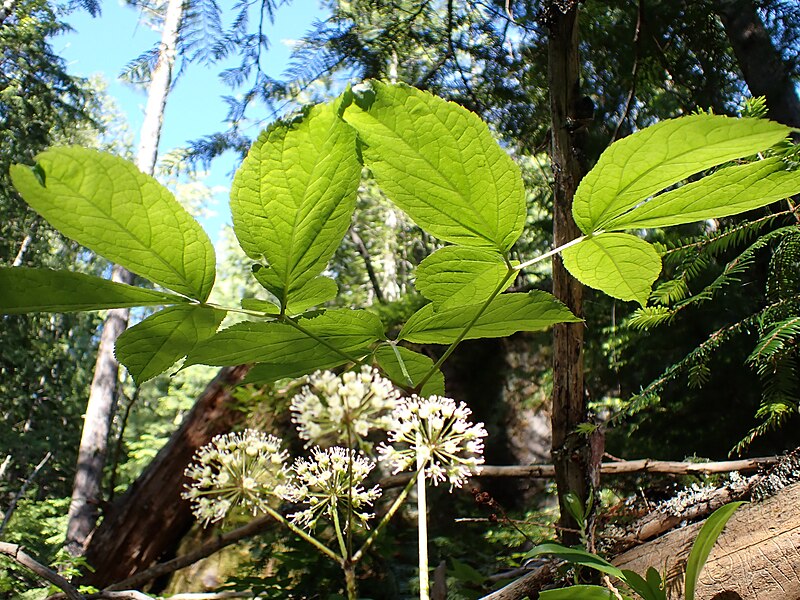
Perennial herb up to 18-24 inches (0.45-0.6 m) tall, with a single compound leaf stalk, and a flower stalk with umbels of flowers. Roots are a rhizome, 1.2 to 4.7 inches (3-12 cm) long, and are aromatic. Stems are a single green, glabrous (hairless) petiole on each plant, averaging 1 foot in length and erect. The leaves are attached to a single, long petiole and are compound, with 2-3 leaflets (typically 3), all located at the top of the petiole. Leaflets are approximately 5 inches long and 2 inches wide, green, obovate, and finely serrate. The inflorescence is on a stalk, branching, with usually 2-4 globose umbels, 1.5-2 inches (3.8-5 cm) across, and is underneath the taller leaves. Flowers within each umbel number up to 40 flowers, have very long pedicels, are small and greenish-white or white, and have very long exerted stamens. Each flower is about 1/8" (3 mm.) wide, with 5 petals. The blooming period occurs from May to early July, depending on site conditions, and lasts about 2-3 weeks. Fruits from the flowers are fleshy berries that are initially green, turning to blue-black with maturity, in the summer and early fall. Seeds number 5 within each berry.
American Ginseng (Panax quinquefolius) and Dwarf Ginseng (Nanopanax trifolius syn. Panax trifolius) are similar to Wild Sarsaparilla, and all are in the same taxonomic family, Araliaceae. Wild Sarsaparilla compound leaves are larger than the ginseng species, and its fruit is blue-black when ripened, versus American Ginseng fruits that are red, and Dwarf Ginseng fruits, which are yellow.
American Ginseng (Panax quinquefolius) and Dwarf Ginseng (Nanopanax trifolius syn. Panax trifolius) are similar to Wild Sarsaparilla, and all are in the same taxonomic family, Araliaceae. Wild Sarsaparilla compound leaves are larger than the ginseng species, and its fruit is blue-black when ripened, versus American Ginseng fruits that are red, and Dwarf Ginseng fruits, which are yellow.
In Georgia, Wild Sarsaparilla is found only in the Blue Ridge Mountains of the state, typically in north-facing cove forests (See Range Map).
Aralia nudicaulis is an herbaceous perennial arising from a long, aromatic rhizome. Flowers appear from late spring into early midsummer, and fruits are present from early summer to fall. Flowers attract bees and flower flies. Berries are ingested by both birds and mammals. The root aroma has led to it being historically used to make root beer, replacing or used with Sassafras.
Aralia nudicaulis may be identified in spring and summer by its fairly large compound leaves and globe-like flower clusters. It can also be identified in summer and early fall by its clusters of blue-black berries.
Throughout eastern and northern North America, more commonly in the northern tier of states with Georgia and South Carolina being the southernmost states in its range, and it is not found in Alabama or states westward. In Georgia, Wild Sarsaparilla is known from the northern mountainous portions of the state (See Range Map).
Logging, conversion of habitat, and development.
Aralia nudicaulis is ranked S2? by the Georgia Department of Natural Resources, indicating that it is imperiled, but needs further assessment, in Georgia. It has been observed in 17 locations in the northern counties in Georgia. Many populations are on conservation land.
Protect known populations from habitat conversion or development if on private land.
Adirondack Forever Wild, 2025. https://wildadirondacks.org/adirondack-wildflowers-wild-sarsaparilla-aralia-nudicaulis.html.
City of Fort Collins, 2025. https://www.fcgov.com/vegetation/?view=123-wild-sarsaparilla.
GADNR. 2025. Element occurrence records for Aralia nudicaulis. Georgia Department of Natural Resources, Wildlife Resources Division, Wildlife Conservation Section. Social Circle, Georgia.
Go Botany, 2025. https://gobotany.nativeplanttrust.org/species/aralia/nudicaulis/.
Illinois Wildflowers. 2025. https://www.illinoiswildflowers.info/woodland/plants/wild_sarsaparilla.htm.
Minnesota Wildflowers, 2006-2025. https://www.minnesotawildflowers.info/flower/wild-sarsaparilla.
NatureServe. 2025. Species account for Aralia nudicaulis. NatureServe Explorer: an online encyclopedia of life. NatureServe Network Biodiversity Location Data accessed through NatureServe Explorer [web application]. NatureServe, Arlington, Virginia. Available https://explorer.natureserve.org/Taxon/ELEMENT_GLOBAL.2.143274/Aralia_nudicaulis.
Weakley, A.S. 2020. Flora of the southeast United States. University of North Carolina at Chapel Hill Herbarium, North Carolina Botanical Garden. University of North Carolina, Chapel Hill.
U.S. Forest Service Fire Effects Information System, 2023. https://www.fs.usda.gov/database/feis/plants/forb/aranud/all.html#BOTANICAL%20AND%20ECOLOGICAL%20CHARACTERISTICS.
Nathan Thomas
27 February 2025