

Loading profile. Please wait . . .
Agalinis georgiana (Boynt.) Pennell
Georgia Agalinis


Federal Protection: No US federal protection
State Protection: No Georgia state protection
Global Rank: G1
State Rank: S1
Element Locations Tracked in Biotics: Yes
SWAP 2015 Species of Greatest Conservation Need (SGCN): Yes
SWAP 2025 Species of Greatest Conservation Need (SGCN): Yes
2025 SGCN Priority Tier: Highest Conservation Concern
Element Occurrences (EOs) in Georgia: 8
Habitat Summary for element in Georgia: Mesic to submesic wiregrass pinelands
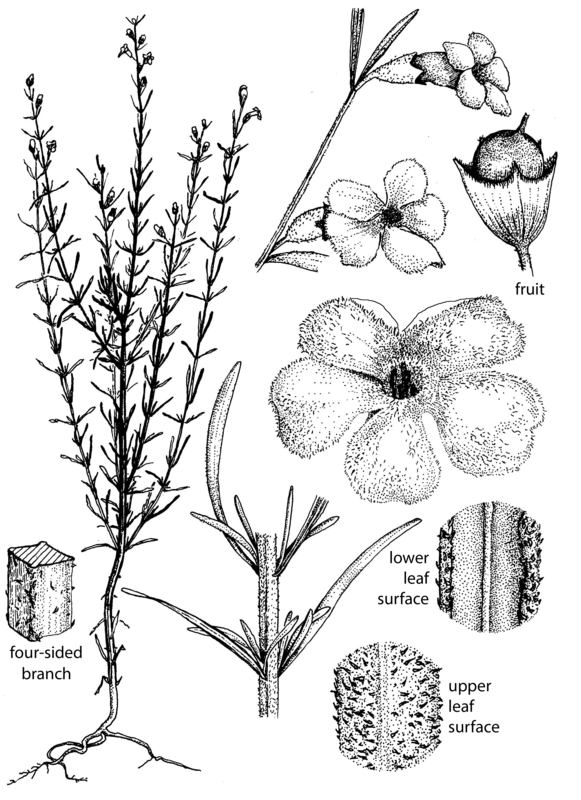
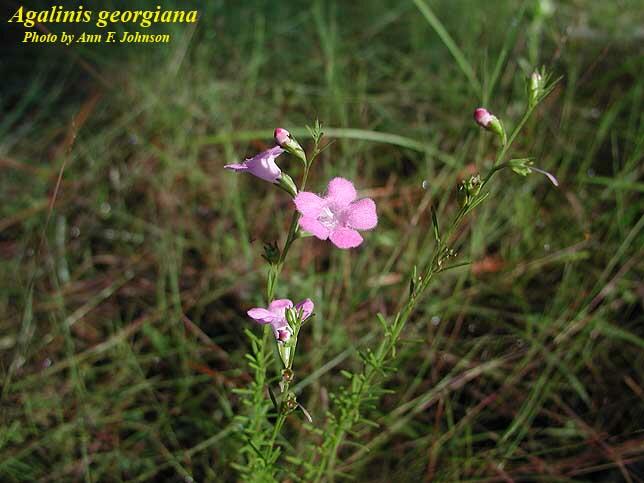
Perennial herb with a light green main stem usually less than 16 inches (40 cm) tall, with erect, light green, 4-sided branches. Primary leaves are up to 0.8 inch (2 cm) long and very narrow (0.4 - 1.5 mm wide), opposite, with rough upper surfaces; small clusters of similar, though often shorter, leaves are usually held in the leaf axils. Flowers are light pink, about 0.5 inch (12 - 14 mm) long, with a short, funnel-shaped tube and five spreading lobes; the flower stalk is less than 0.2 inch (5 mm) long. The flowers are hairy on the outer surface and also inside the tube; the darker lines or spots (nectar guides) inside the tube that characterize most Agalinis are usually absent in this species. The style is short and does not extend beyond the rim of the tube. Fruit is a round capsule less than 0.2 inch (3.5 - 5 mm) wide.
Georgia Purple Foxglove resembles and often grows with the very common Purple Foxglove (Agalinis fasciculata). A coarse, bushy plant, Purple Foxglove stems are dark green and 2 - 6 feet (0.6 - 2 meters) tall. Its flowers are larger than 0.5 inch (1.25 cm) and are darker in color – purple-pink – with dark purple spots and 2 yellow lines on the inner surface. Its style extends well beyond the rim of the flower.
Ten other species of Agalinis are rare in Georgia.
Three species occur in moist to wet Coastal Plain habitats such as wet flatwoods, savannas, and pitcherplant bogs that are similar to Georgia Purple Foxglove’s habitat: Scale-leaf Purple Foxglove (A. aphylla), Spindly Purple Foxglove (A. filicaulis), and St. Mark’s Purple Foxglove (A. harperi).
Four rare Agalinis occur in dry, longleaf pine-wiregrass sandhills in the Coastal Plain: Sprawling Purple Foxglove (A. divaricata), Seminole Purple Foxglove (A. filifolia), Lax Purple Foxglove (A. laxa), and Few-flowered Purple Foxglove (Agalinis tenella).
Saltmarsh Purple Foxglove (Agalinis maritima var. grandiflora) occurs in salt marshes on Georgia’s coast.
Two rare Agalinis species occur in dry, open woods and glades in the Ridge & Valley and Appalachian Plateau of northwest Georgia: Purple Foxglove (A. decemloba) and Gattinger's Purple Foxglove (A. gattingeri). For more information, see: https://www.georgiabiodiversity.org/portal/profile?group=plants&es_id=15912
Moist to wet pine savannas and flatwoods, usually with Longleaf Pine and Wire Grass, and seepage slope herb bogs, including pitcherplant bogs.
Like all members of the genus Agalinis, Georgia Purple Foxglove is a hemi-parasite – it has green leaves and conducts photosynthesis to obtain organic nutrients, but extracts water and minerals from other plants, often grasses. It connects to its host plant by haustoria, small peg-like structures on its roots that penetrate the roots of the host plant and extract water and nutrients.
Georgia Purple Foxglove has a very short life cycle, often flowering, setting fruit, and dying back within a month. Little is known about reproduction in this species. Most of the other Purple Foxglove species are pollinated by bees, who use the dark lines and dots inside the flower to guide them; however, Georgia Purple Foxglove lacks these colorations – the effect on pollination is not known. After fertilization takes place, the flower is replaced by small, rounded capsules that split open to release many tiny seeds that are dispersed by the wind. Plants apparently do not appear every year, even after prescribed fire has been applied.
Because of its resemblance to several other Purple Foxglove species, surveys are best conducted during flowering, late August–late September, when the length of the pedicel and lack of nectar guides on the corolla are obvious. Records indicate that plants don’t always appear at known sites, even after a fire so multi-year surveys are recommended.
Georgia Purple Foxglove occurs in the East Gulf Coastal Plain of Georgia (historically, five counties), Alabama (one county), and Florida (five counties).
Conversion of habitat to pine plantations, pastures, agriculture, or developments. Fire suppression in sandhills, flatwoods, savannas, seepage slopes, bogs, and woodlands. Disturbances such as road-building and firebreak construction in transitional areas (ecotones) between uplands and wetlands. Disruption of natural hydrology in flatwoods, seepage slopes, and bogs.
| Threat 1 | Threat 2 | Threat 3 | |
|---|---|---|---|
| General Threat | Agriculture & aquaculture | Natural system modifications | Natural system modifications |
| Specific Threat | None | None | None |
Agalinis georgiana is ranked S1 by the Georgia Department of Natural Resources, indicating that it is critically imperiled in the state. Five populations of Georgia Purple Foxglove have been documented in three counties since 2008. None of these populations occur on publicly owned land, but two are owned by private conservation organizations and are ecologically managed with fire, as is a third population on private hunting land.
Apply prescribed fire to Coastal Plain pine flatwoods, savannas, seepage slopes, and bogs every 2 - 3 years early in the growing season. Avoid placing roads and firebreaks through these habitats and in the transition zones between wetlands and uplands. Protect the plant communities from conversion to pine plantations, pastures, agriculture, or development. Eradicate feral hogs.
GADNR. 2019. Element occurrence records for Agalinis georgiana. Georgia Department of Natural Resources, Wildlife Resources Division, Social Circle.
Hays, J.F., III. 2002. Agalinis Raf. (Scrophulariaceae) of the East Gulf Coastal Plain. M.S. Thesis, University of Louisiana, Monroe.
Hays, J.F., III. 2000. Historic species of Agalinis relocated in Alabama. Chinquapin 8(2): 1.
Hays, J. 2002. Final report for the status survey of the rare endemic plant species Agalinis georgiana (C.L. Boynton) Pennell. Submitted to US Fish and Wildlife Service, 6578 Dogwood View Parkway, Suite A, Jackson MS.
Pennell, F.W. 1913. Studies in the Agalinanae, a subtribe of the Rhinanthaceae II: species of the Atlantic Coastal Plain. Bulletin of the Torrey Botanical Club 40 (8): 401-439. https://www.jstor.org/stable/2479817?seq=1#metadata_info_tab_contents
Pennell, F.W. 1929. Agalinis and Allies in North America – II. Proceedings of the Academy of Natural Sciences of Philadelphia 81: 111-249. https://www.jstor.org/stable/4064033?seq=1#metadata_info_tab_contents
Weakley, A.S. 2020. Agalinis of Georgia. University of North Carolina Herbarium, Chapel Hill.
Wunderlin, R. P., B. F. Hansen, A. R. Franck, and F. B. Essig. 2019. Atlas of Florida Plants. (http://florida.plantatlas.usf.edu/). [S. M. Landry and K. N. Campbell (application development), USF Water Institute.] Institute for Systematic Botany, University of South Florida, Tampa.
Linda G. Chafin
Linda G. Chafin, April 2019: original account