

Loading profile. Please wait . . .
Rhynchospora crinipes Gale
Hairy-peduncled Beaksedge


Federal Protection: No US federal protection
State Protection: No Georgia state protection
Global Rank: G3
State Rank: S1
Element Locations Tracked in Biotics: Yes
SWAP 2015 Species of Greatest Conservation Need (SGCN): Yes
SWAP 2025 Species of Greatest Conservation Need (SGCN): Yes
2025 SGCN Priority Tier: High Conservation Concern
Element Occurrences (EOs) in Georgia: 9
Habitat Summary for element in Georgia: Streambanks and shallow streambeds
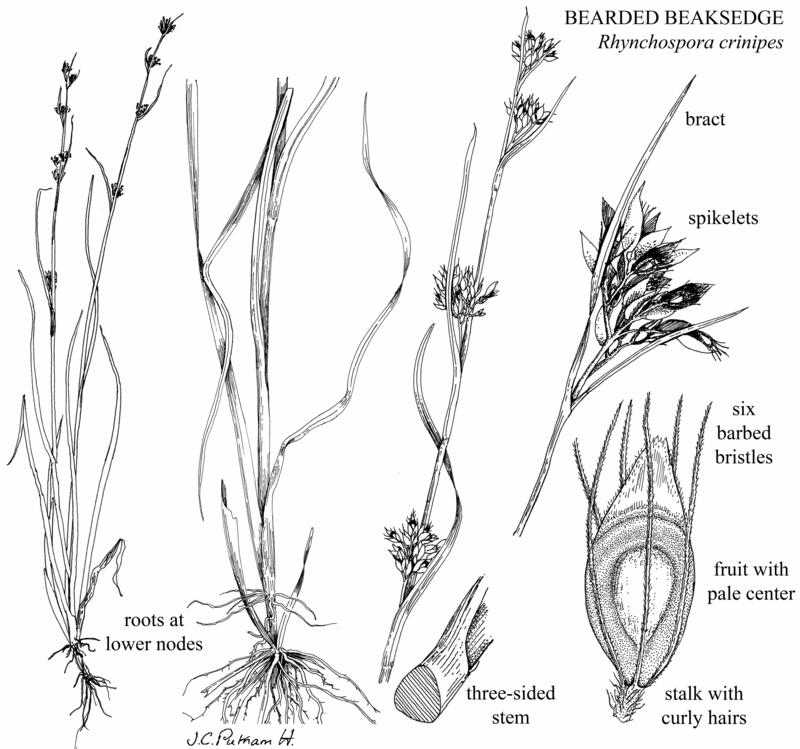
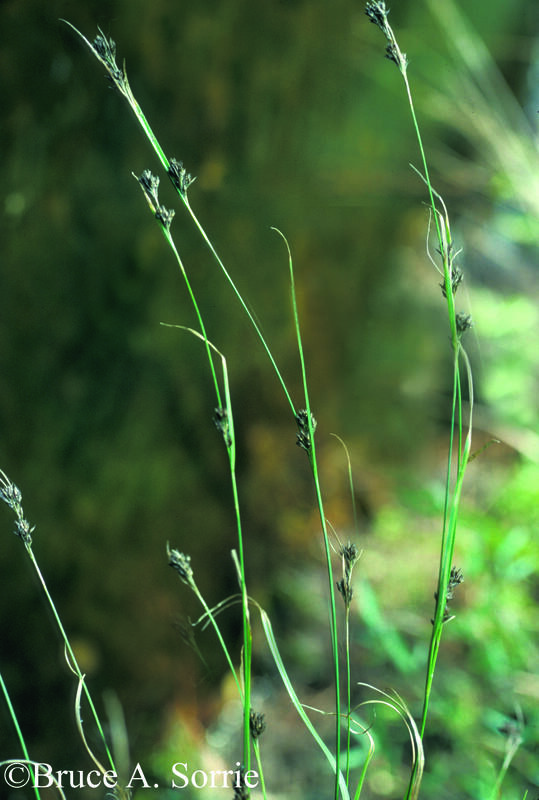
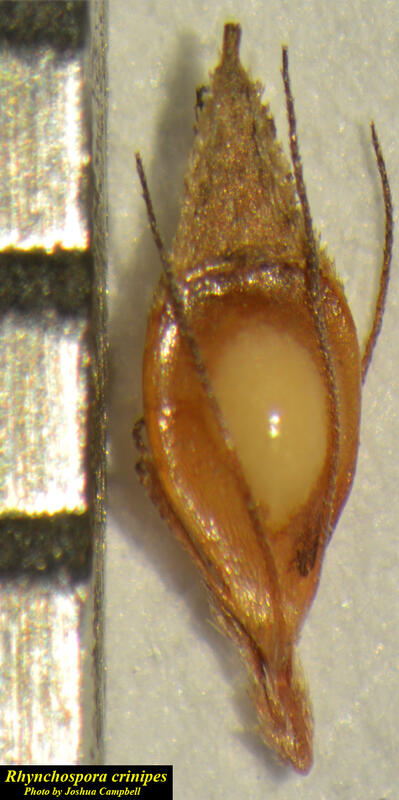
Perennial herb, solitary or forming clumps. Stems are 2 - 3.3 feet tall (60 - 100 cm), slightly 3-angled, leafy, flexible, curving, sometimes rooting at lower nodes. The leaves are shorter than the stem and less than 0.2 inch (2 - 5 mm) wide, flat with a long, pointed tip. Flower clusters are widely spaced on the upper part of the stem, 3 - 10 clusters per stem; each cluster has several narrow, pointed spikelets and a long, leafy bract. Spikelets are up to 0.2 inch (5 mm) long, covered with reddish-brown scales and containing 2 - 4 shiny, brown, seed-like fruits. Fruits are less than 0.1 inch (1.7 - 2.5 mm) long, including the pointed tip (tubercle) and the stalk; they are glossy brown with a pale center and 6 barbed bristles attached to the base; fruits are each attached to a tiny stalk covered with curly, white hairs. Beaksedge species are difficult to identify; 10x or higher magnification is needed to examine the fruits.
Thread-leaved Beaksedge (Rhynchospora filifolia) is a smaller plant with a thin, wiry stem often leaning on other plants; it has 2 - 3 flower clusters per stem; the fruit stalk has only bristles, not hairs.
Loose-head Beaksedge (Rhynchospora chalarocephala) does not form clumps; its scales are dark brown and the fruit stalks lack hairs.
Fifteen species of Rhynchospora are rare in Georgia. For more information, see:
Northern White Beaksedge (Rhynchospora alba) http://beta.floranorthamerica.org/Rhynchospora_alba
Bearded Beaksedge (Rhynchospora crinipes) https://www.georgiabiodiversity.org/portal/profile?group=plants&es_id=20946
Georgia Beaksedge (Rhynchospora culixa) https://www.georgiabiodiversity.org/portal/profile?group=plants&es_id=17285
Decurrent Beaksedge (Rhynchospora decurrens) https://www.georgiabiodiversity.org/portal/profile?group=plants&es_id=21032
Fernald's Beakrush (Rhynchospora fernaldii) https://www.georgiabiodiversity.org/portal/profile?group=plants&es_id=20462
Harper's Beaksedge (Rhynchospora harperi) https://www.georgiabiodiversity.org/portal/profile?group=plants&es_id=17092
Many-bristled Beaksedge (Rhynchospora macra) https://www.georgiabiodiversity.org/portal/profile?group=plants&es_id=19539
Feather-bristle Beaksedge (Rhynchospora oligantha) http://beta.floranorthamerica.org/Rhynchospora_oligantha
Clonal Thread-leaved Beak (Rhynchospora pleiantha) https://www.georgiabiodiversity.org/portal/profile?group=plants&es_id=19634
Spotted Beaksedge (Rhynchospora punctata) https://www.georgiabiodiversity.org/portal/profile?group=plants&es_id=20475
Long-beak Beaksedge (Rhynchospora scirpoides) http://beta.floranorthamerica.org/Rhynchospora_scirpoides
Solitary Beaksedge (Rhynchospora solitaria) https://www.georgiabiodiversity.org/portal/profile?group=plants&es_id=21235
Chapman's Beakrush (Rhynchospora stenophylla) http://beta.floranorthamerica.org/Rhynchospora_stenophylla
Thorne’s Beaksedge (Rhynchospora thornei) https://www.georgiabiodiversity.org/portal/profile?group=plants&es_id=22487
Torrey's Beaksedge (Rhynchospora torreyana) http://beta.floranorthamerica.org/Rhynchospora_torreyana
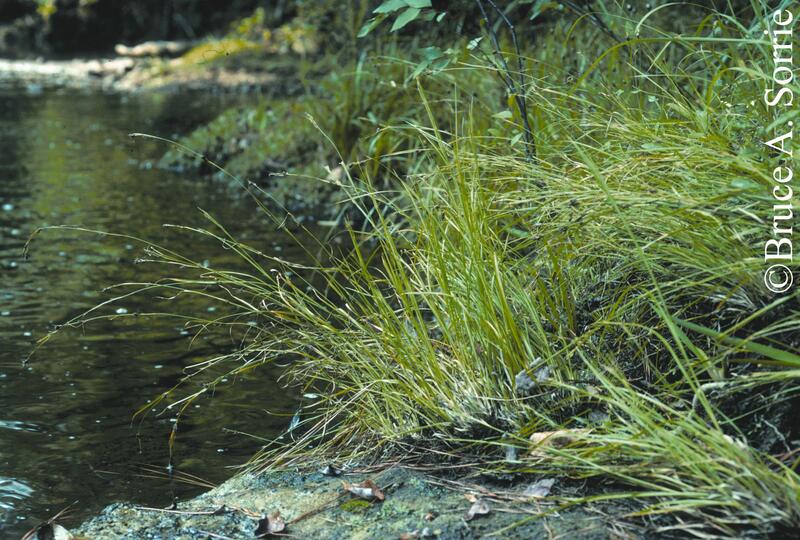
Sandy, gravelly, or peaty banks and sandbars of blackwater streams and spring runs, in full sun or light shade. Sometimes rooted on stumps and tree bases.
Bearded Beaksedge is a perennial herb that reproduces sexually as well as vegetatively by forming clumps from lateral offshoots and by the spread of rhizomes and stolons. All beaksedge flowers are wind-pollinated; their fruits are dispersed by water and gravity, and also by animals, assisted by the tiny, barbed bristles at the base of the fruit which attach to fur and feathers.
Surveys are best conducted during fruiting (July–frost) because fruits are needed for identification.
Coastal Plain and Fall Line ecoregions of Georgia; also Florida, Alabama, Mississippi, and North Carolina.
Degradation of stream quality by pollution and sedimentation. Stream impoundment. Changes in stream hydrology. Clearcutting and timber harvest in streamside zones. Stream bank grazing by stock animals. Changes in hydrology due to altered temperature and rainfall patterns related to climate change are likely to negatively effect this species.
| Threat 1 | Threat 2 | Threat 3 | |
|---|---|---|---|
| General Threat | Energy production & mining | Transportation & service corridors | Biological resource use |
| Specific Threat | None | None | None |
Rhynchospora crinipes is ranked S1 by the Georgia Department of Natural Resources, indicating that it is critically imperiled in Georgia. Nine populations have been documented in Georgia, but none have been confirmed since 1995. No populations have been observed on conservation land.
Prevent erosion and sedimentation into streams during bridge-building, road construction, timber harvesting, and other clearing. Maintain streamside buffer zones. Avoid impoundment of small blackwater streams. Exclude grazing stock from streamsides. Address hydrological threats related to climate change.
Anderson, L.C. 1988. Status of endangered Rhynchospora crinipes (Cyperaceae). Systematic Botany 13(3): 407-410. https://www.jstor.org/stable/2419300?seq=1#metadata_info_tab_contents
Chafin, L.G. 2007. Field guide to the rare plants of Georgia. State Botanical Garden of Georgia and University of Georgia Press, Athens.
GADNR. 2020. Element occurrence records for Rhynchospora crinipes. Georgia Department of Natural Resources, Wildlife Resources Division, Social Circle, Georgia.
Gale, S. 1944. Rhynchospora, section Eurhynchospora, in Canada, the United States, and the West Indies. Rhodora 46(2): 169-175. https://www.jstor.org/stable/23302306?seq=1#metadata_info_tab_contents
Godfrey, R.K. and J.W. Wooten. 1979. Aquatic and wetland plants of southeastern United States, Vol. 1, monocotyledons. University of Georgia Press, Athens.
Kral, R. 2003. Rhynchospora crinipes species account. Flora of North America, Vol. 23. Oxford University Press, New York. http://www.efloras.org/florataxon.aspx?flora_id=1&taxon_id=242357872
Kral, R. 1983. A report on some rare, threatened, or endangered forest-related vascular plants of the South. Technical Publication R8-TP2. United States Forest Service, Atlanta.
Kral, R. 1996. Supplemental notes on Rhynchospora crinipes and related species in Section Fuscae (Cyperaceae). Sida 17(2): 385-411. https://www.jstor.org/stable/41967219?seq=1#metadata_info_tab_contents
NatureServe. 2019. Rhynchospora crinipes comprehensive report. NatureServe Explorer. Arlington, Virginia. http://explorer.natureserve.org/servlet/NatureServe?searchName= Rhynchospora+crinipes
Weakley, A.S. 2015. Flora of the southern and mid-Atlantic States. University of North Carolina Herbarium, University of North Carolina, Chapel Hill. http://www.herbarium.unc.edu/flora.htm
Linda G. Chafin
L. Chafin, Aug. 2008: original account
K. Owers, Feb. 2010: added pictures
L. Chafin, Apr. 2020: updated original account