

Loading profile. Please wait . . .
Rudbeckia auriculata (Perdue) Kral
Swamp Black-eyed Susan


Federal Protection: No US federal protection
State Protection: Endangered
Global Rank: G2
State Rank: S1
Element Locations Tracked in Biotics: Yes
SWAP 2015 Species of Greatest Conservation Need (SGCN): Yes
SWAP 2025 Species of Greatest Conservation Need (SGCN): Yes
2025 SGCN Priority Tier: Highest Conservation Concern
Element Occurrences (EOs) in Georgia: 2
Habitat Summary for element in Georgia: Swampy woods
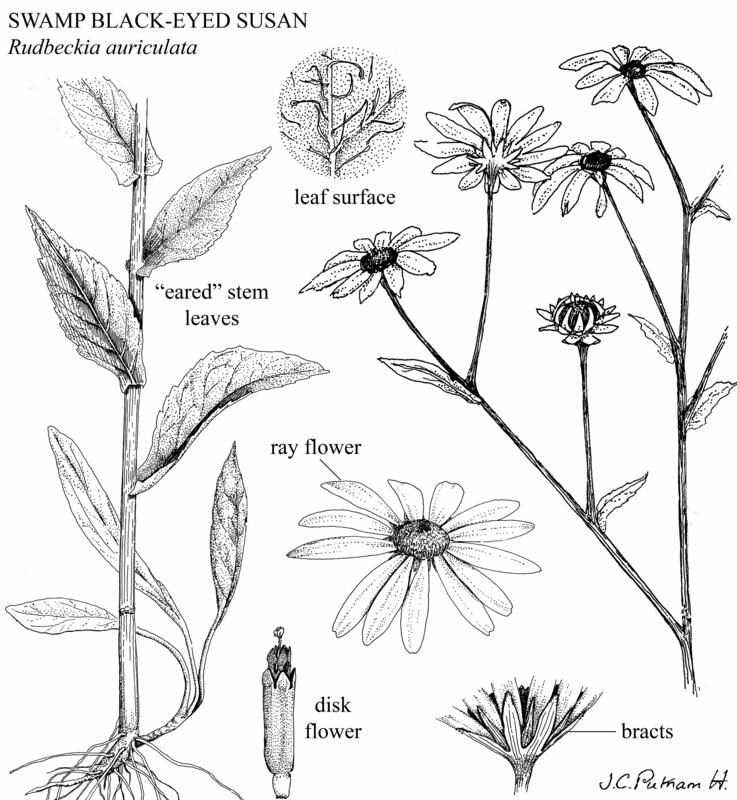
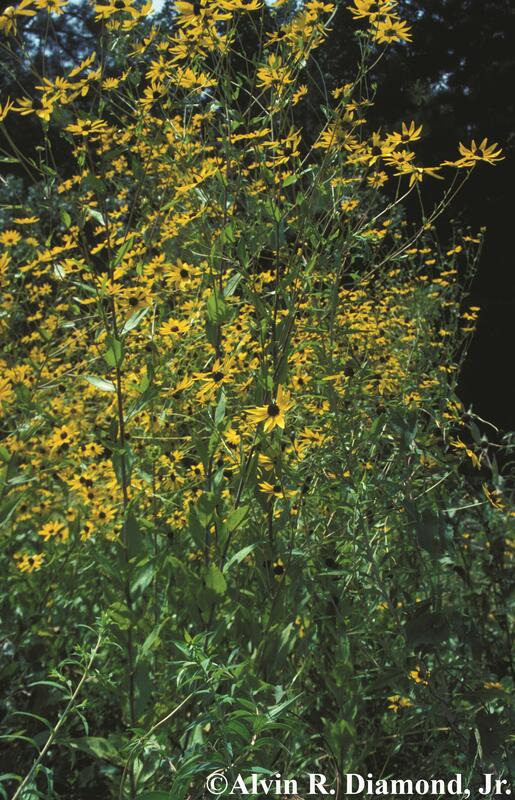
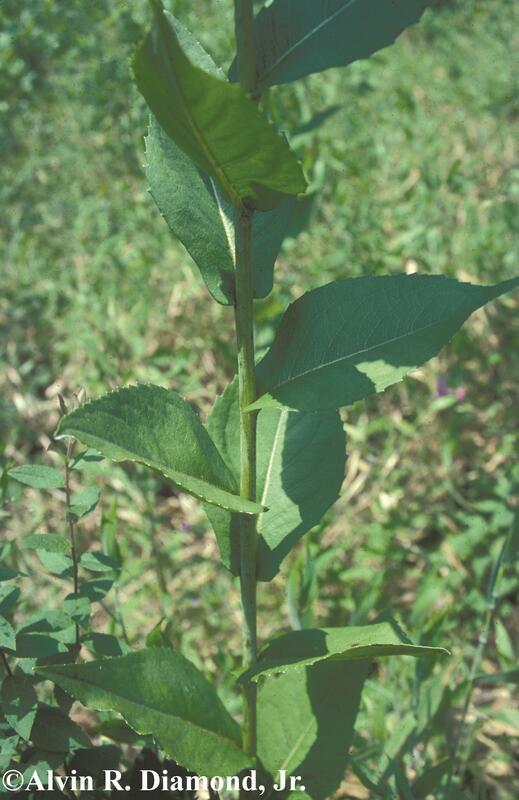
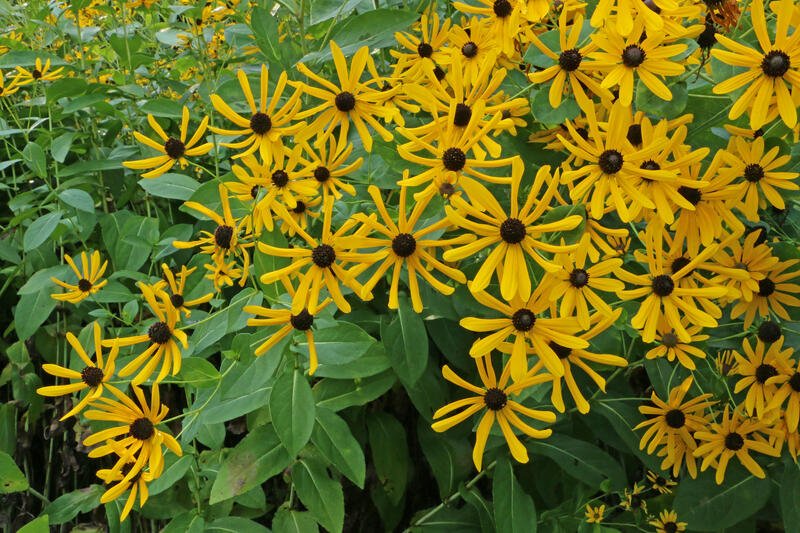
Perennial herb with smooth, erect stems up to 10 feet (300 cm) tall. The lower leaf blades are up to 2 feet (20 - 65 cm) long and 3 - 8 inches (8 - 20 cm) wide, alternate, oval or lance-shaped, with rounded or pointed tips, smooth or hairy surfaces, entire or toothed edges; leaf stalks are ⅓ - ½ the total length of the leaves. Upper and midstem leaves decrease in size up the stem, lack leaf stalks, and clasp the stem with “eared” bases. Flower clusters are large, much-branched, and open, with many heads. Flower heads have a cone- or dome-shaped, purple-brown disk, 0.4 - 0.7 inch (1 - 1.7 cm) wide; 8 - 14 bright yellow ray flowers about 1 inch (1.8 - 3 cm) long; and 1 - 3 whorls of stiff, greenish involucral bracts surrounding the base of the head. Fruits are less than 0.2 inch (3.5 - 5 mm) long, seed-like, shiny, and reddish-brown, with 4 ribs.
Cut-leaved Coneflower (Rudbeckia laciniata) is a similar plant that occurs in the same habitat as Swamp Black-eyed Susan. Its leaves are usually dissected or lobed, and its disk flowers are yellow-green.
Four species of Rudbeckia are rare in Georgia:
Rudbeckia auriculata (Swamp Black-eyed Susan) occurs on streambanks and stream islands and swampy woods in the Coastal Plain. For more information, see: https://www.georgiabiodiversity.org/portal/profile?group=plants&es_id=21146
Rudbeckia fulgida var. speciosa (Showy Orange Coneflower) occurs on limestone barrens and in open woods over basic soils in northwest Georgia. For more information, see: http://beta.floranorthamerica.org/Rudbeckia_fulgida_var._speciosa
Rudbeckia grandiflora (Large-flowered Coneflower, Special Concern) occurs on limestone glades in Catoosa County. For more information, see: http://beta.floranorthamerica.org/Rudbeckia_grandiflora
Rudbeckia heliopsidis (Little River Black-eyed Susan) occurs on limestone or sandstone glades and rocky streambanks in northwest Georgia. For more information, see: https://www.georgiabiodiversity.org/portal/profile?group=plants&es_id=20481
Sunny wet meadows, bogs, and seeps; edges of swamps and floodplains; stream banks, sand bars and river islands; wet rock outcrops; roadside ditches and rights-of-way through these habitats.
Swamp Black-eyed Susan is a perennial herb that reproduces sexually by seed as well as vegetatively by the spread of rhizomes. Its flowers are pollinated by bees, and will not set fruit unless cross-pollinated. Bees also spread the pollen-mimicing spores of a fungus, Fusarium semitectum, that infects the flowers and renders them sterile. Small populations of Swamp Black-eyed Susan attract many fewer pollinators than do larger, showier stands, and often fail to produce seeds. In large populations, seeds are produced and then dispersed by gravity and flowing water, if nearby. However, seedlings are seldom seen in the wild, probably because of a lack of suitable seedbed. Swamp Black-eyed Susan seeds will germinate only on cleared patches of bare mineral soil produced by disturbances such as fire and stream scouring – natural processes that have been interrupted at many sites by human interference.
Surveys are best conducted during flowering (July–September).
Georgia, Florida, and Alabama.
Fire suppression, impoundment and pollution of streams, conversion of habitat to pine plantations, agriculture, and developments; broadcast use of herbicides in highway rights-of-way; invasion by exotic pest plants; grazing in streamside zones; browsing by deer. Changes in hydrology due to altered temperature and rainfall patterns related to climate change are likely to negatively effect this species.
| Threat 1 | Threat 2 | Threat 3 | |
|---|---|---|---|
| General Threat | Natural system modifications | Invasive & other problematic species, genes & diseases | Pollution |
| Specific Threat | None | None | None |
Rudbeckia auriculata is ranked S1 by the Georgia Department of Natural Resources, indicating that it is critically imperiled in the state. It is also listed as Endangered by the State of Georgia. Two populations have been documented in Georgia. One occurs on private conservation land, the other in a floodplain by a U.S. highway bridge where it is vulnerable to road maintenance and widening.
Use prescribed fire or hand-clearing to remove competing vegetation. Avoid mechanical disturbances, such as silvicultural site preparation, to the ground cover. Avoid use of herbicides in rights-of-way, and mow early in the year to avoid flowering period. Eradicate exotic pest plants. Protect plants from sedimentation and erosion caused by highway right-of-way maintenance and road widening. Protect plants from cattle grazing and deer browsing. Research long-term impact of Fusarium semitectum infection. Monitor populations for impact of climate change and exotic species. Because this species is dependent on pollinators to set fruit, effective conservation depends on protection of pollinator populations.
Chafin, L.G. 2007. Field guide to the rare plants of Georgia. State Botanical Garden of Georgia and University of Georgia Press, Athens.
Cronquist, A. 1980. Vascular flora of the southeastern United States, Vol. 1, Asteraceae. University of North Carolina Press, Chapel Hill.
Diamond, A.R. 2006. Ecology of Rudbeckia auriculata (Perdue) Kral (Asteraceae). Dissertation, Auburn University, Auburn, Alabama. https://etd.auburn.edu/bitstream/handle/10415/526/DIAMOND_ALVIN_34.pdf?sequence=1&isAllowed=y
Diamond, A.R., Jr. and R.S. Boyd. 2004. Distribution, habitat characteristics, and population trends of the rare southeastern endemic Rudbeckia auriculata (Perdue) Kral (Asteraceae). Castanea 69(4): 249-264. https://doi.org/10.2179/0008-7475(2004)069<0249:DHCAPT>2.0.CO;2
Diamond Jr., A.R., D.R. Folkerts, and R.S. Boyd. 2006. Pollination biology, seed dispersal, and recruitment in Rudbeckia auriculata (Perdue) Kral, a rare southeastern endemic. Castanea 71(3): 226-238. https://doi.org/10.2179/05-20.1
Urbatsch, L.E. and P.B. Cox. 2006. Species account for Rudbeckia auriculata. Flora of North America, Vol. 21. http://beta.floranorthamerica.org/Rudbeckia_auriculata
Godfrey, R.K. and J.W. Wooten. 1981. Aquatic and wetland plants of southeastern United States, Vol. 2, dicotyledons. University of Georgia Press, Athens.
Kral, R. 1975. Rudbeckia auriculata (Perdue) Kral, a species distinct from R. fulgida Aiton. Rhodora 77(809): 44-52. https://www.jstor.org/stable/23311808?seq=1#metadata_info_tab_contents
Kral, R. 1983. A report on some rare, threatened, or endangered forest-related vascular plants of the South. Technical Publication R8-TP2. United States Forest Service, Atlanta.
NatureServe. 2020. Species account for Rudbeckia auriculata. NatureServe Explorer. Arlington, Virginia. https://explorer.natureserve.org/Taxon/ELEMENT_GLOBAL.2.143162/Rudbeckia_auriculata
Schotz, A.R. 2000. Status survey report on Eared Coneflower (Rudbeckia auriculata) in Alabama. Alabama Natural Heritage Program, Auburn University, Auburn.
Weakley, A.S. 2015. Flora of the southern and mid-Atlantic States. University of North Carolina Herbarium, University of North Carolina, Chapel Hill. http://www.herbarium.unc.edu/flora.htm
Linda G. Chafin
L. Chafin, Aug. 2008: original account
K. Owers, Feb. 2010: added pictures
L. Chafin, May 2020: updated original account.