

Loading profile. Please wait . . .
Stylisma pickeringii var. pickeringii
Pickering's Morning-glory


Federal Protection: No US federal protection
State Protection: Threatened
Global Rank: G4T3
State Rank: S2
Element Locations Tracked in Biotics: Yes
SWAP 2015 Species of Greatest Conservation Need (SGCN): No
SWAP 2025 Species of Greatest Conservation Need (SGCN): Yes
2025 SGCN Priority Tier: High Conservation Concern
Element Occurrences (EOs) in Georgia: 46
Habitat Summary for element in Georgia: Open, dry, oak scrub of sandhills
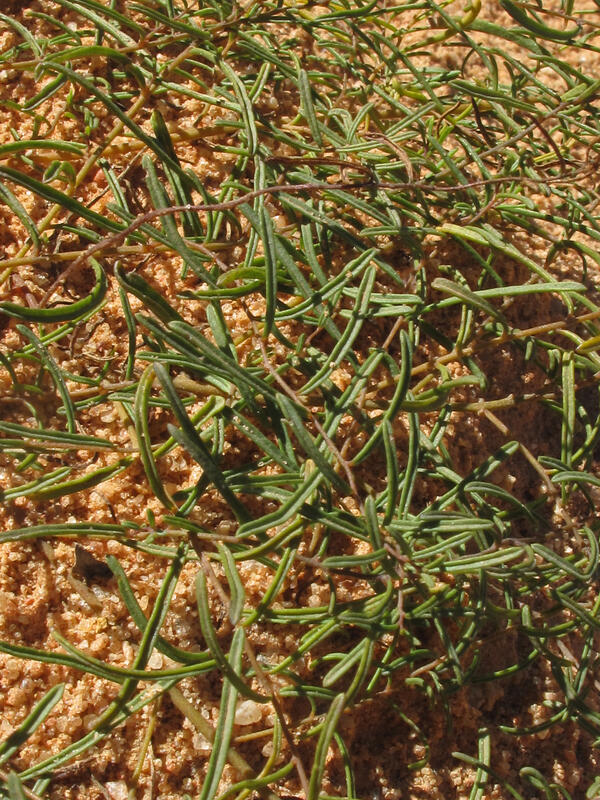
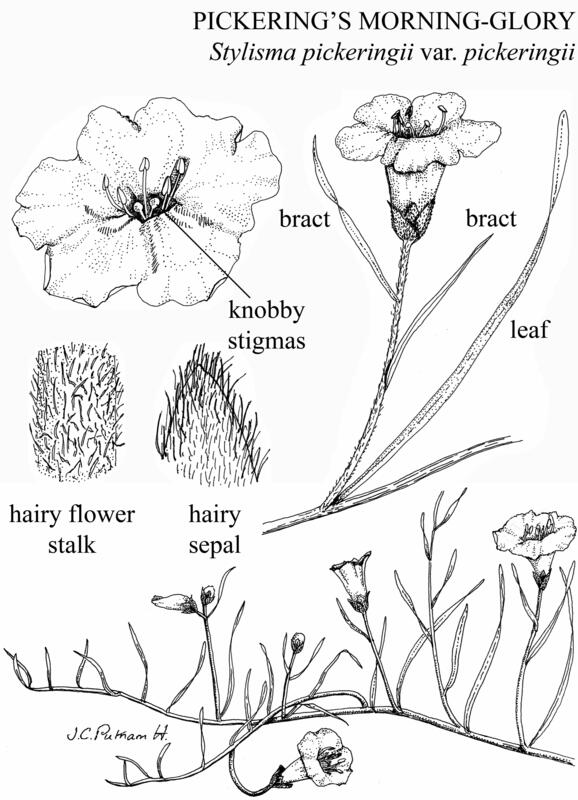
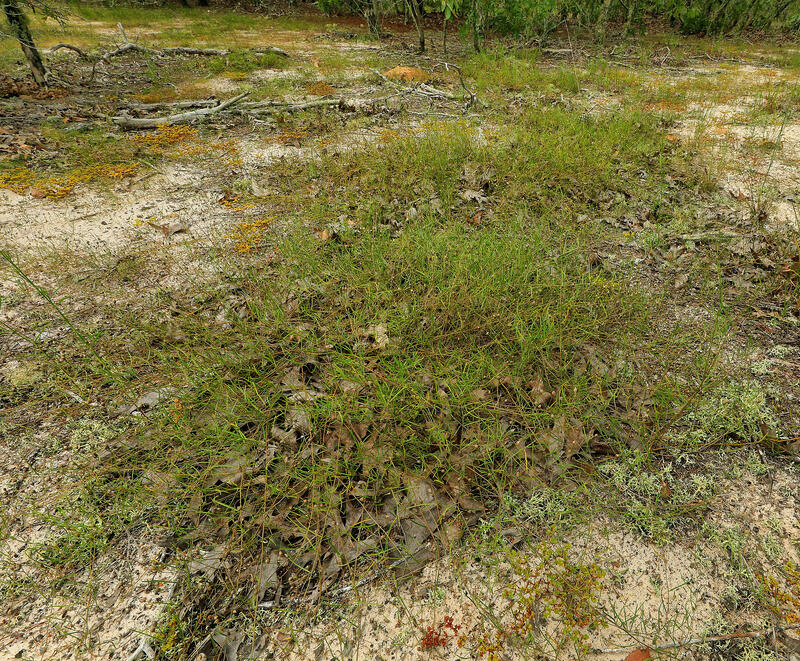
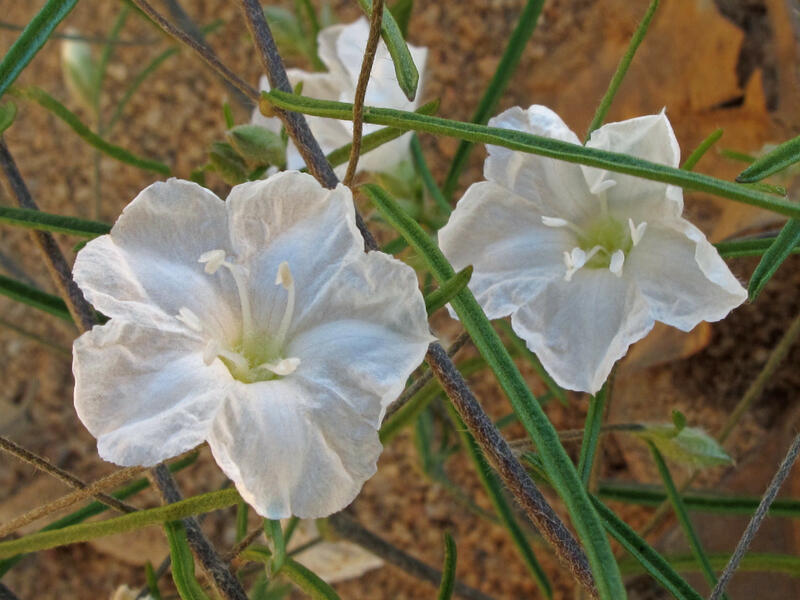
Perennial, herbaceous vine with stems up to 6 feet (2 meters) long, arching from a central crown and spreading radially into large mats up to 6 feet (2 meters) in diameter. The leaves are 1 - 2.8 inches (2.5 - 7 cm) long and less than 0.1 inch (1 - 3 mm) wide, held upright. Flowers are 0.5 - 0.7 inch (1.2 - 1.8 cm) across, white, funnel-shaped with 5 rounded lobes and 5 sepals covered with golden hairs; there are up to 5 flowers per stalk. The flower stalk is 1.2 - 2.7 inches (3 - 7 cm) long, hairy, rising from the angle of leaf and stem, with 2 leaf-like bracts that are 0.5 - 1 inch (1.5 - 2.5 cm) long. In the center of the flower are 5 stamens and a pistil with its style barely divided into two very short branches, each branch topped by a tiny, knob-like stigma. Fruits are round capsules 0.24 inch (6 mm) wide.
Dawnflower (Stylisma patens) is another white-flowered morning-glory vine with narrow leaves that occurs in sandhills. Its leaves are held horizontally; the bracts on the flower stalk are less than 0.2 inch (5 mm) long, very narrow, and not leaf-like; and, the style is deeply divided into two long branches.
Creeping Morning-glory (Evolvulus sericeus var. sericeus, Endangered) occurs on Altamaha Grit outcrops, calcareous uplands, wet flatwoods, seepages and bogs in the Coastal Plain. For more information, see: https://www.georgiabiodiversity.org/portal/profile?group=plants&es_id=16594
Bare, sandy soils of sandhills on the Fall Line and sandy relict dune ridges along Coastal Plain rivers, with scattered Turkey Oak and Longleaf Pine; also on roadsides and other disturbed areas through these habitats.
Pickering’s Morning-glory is a perennial herbaceous vine that reproduces sexually by seed. It flowers profusely, with individual plants producing hundreds of fruits and seeds. Individual flowers last for only one day; they open in early morning, remain open for 6 - 8 hours, then wither. They are pollinated primarily by bees. Its seeds germinate best on bare mineral soils, such as those created by fire and flood scouring, and often germinate shortly after falling from the fruit if soil conditions are right. After germination, the earliest seedling growth takes place within a cavity in the seed that remains underground, protecting the new growth from the harsh conditions – drought, fire, high levels of sunlight – that occur on sandhills and sand ridges. All subsequent aboveground growth derives from these protected shoots.
Surveys are best conducted during flowering (late May–mid-August) and fruiting (June–October), but the mat-forming habit and narrow, upright leaves are diagnostic throughout the growing season.
Georgia, Alabama, South Carolina, North Carolina, and New Jersey (NJ plants are sometimes considered a separate variety). It is rare throughout its range.
Conversion of habitat to pine plantations, pastures, fields, and commercial and residential developments; fire suppression, shading, and competition by woody plants.
| Threat 1 | Threat 2 | Threat 3 | |
|---|---|---|---|
| General Threat | Energy production & mining | Agriculture & aquaculture | Natural system modifications |
| Specific Threat | None | None | None |
Stylisma pickeringii var. pickeringii is ranked S2 by the Georgia Department of Natural Resources, indicating that the species is imperiled in Georgia. It is listed as Threatened by the State of Georgia. Forty-five populations have been documented in Georgia, but only 14 have been confirmed since 2000. Six populations were documented on state conservation lands and 16 on military installations.
Burn sandhills and riverine sand dunes every 2 - 3 years. Protect sandhills and riverine sand dunes from clearcutting, site preparation, conversion to pine plantations and developments, and off-road vehicle traffic. Eradicate exotic pest plants such as Rattleweeds (Crotalaria spp.).
Chafin, L.G. 2007. Field guide to the rare plants of Georgia. State Botanical Garden of Georgia and University of Georgia Press, Athens.
Cunningham, J.B. 2006. Seedling development in Stylisma pickeringii var. pattersonii (Convolvulaceae), an endangered Illinois species. Master's Thesis, Eastern Illinois University. http://thekeep.eiu.edu/theses/726
GADNR. 2020. Element occurrence records for Stylisma pickeringii var. pickeringii. Georgia Department of Natural Resources, Wildlife Resources Division, Social Circle, Georgia.
Kelly, A.W. and A.S. Weakley. 1992. Stylisma pickeringii var. pickeringii, Pickering’s dawnflower: results of a global status survey and proposal to list as a threatened species. The Nature Conservancy, Boston.
Myint, T. 1966. Revision of the genus Stylisma (Convolvulaceae). Brittonia 18(2): 97-117. https://www.jstor.org/stable/2805192?seq=1#metadata_info_tab_contents
NatureServe. 2020. Stylisma pickeringii var. pickeringii species account. NatureServe Explorer. Arlington, Virginia. https://explorer.natureserve.org/Taxon/ELEMENT_GLOBAL.2.152853/Stylisma_pickeringii_var_pickeringii
Patrick, T.S., J.R. Allison, and G.A. Krakow. 1995. Protected plants of Georgia. Georgia Department of Natural Resources, Natural Heritage Program, Social Circle.
Todd, B.L., H.R. Owen, and J.M. Coons. 2001. Reproductive potential of Stylisma pickeringii (Patterson Bindweed), an endangered plant of Illinois sand prairies, in disturbed and undisturbed areas. Transactions of the Illinois State Academy of Science 94:52.
Todd, B.L. 2002. Reproductive biology of Stylisma pickeringii (Convolvulaceae), an endangered plant of Illinois Sand Prairies. M.S. Thesis, Eastern Illinois University. https://thekeep.eiu.edu/theses/1497
Todd, B.L., H.R. Owen, J.M. Coons, and C.J. Heisler. 2001. Seed germination and seedling development of Stylisma pickeringii (Patterson Bindweed), an Illinois-endangered sand prairie species. Proceedings of the Botanical Society of America meetings at Albuquerque, New Mexico.
Weakley, A.S. 2015. Flora of the southern and mid-Atlantic States. University of North Carolina Herbarium, University of North Carolina, Chapel Hill. http://www.herbarium.unc.edu/flora.htm
Linda G. Chafin
L. Chafin, Sep. 2008: original account
D. Weiler, Feb. 2010: added pictures
L. Chafin, May 2020: updated original account