

Loading profile. Please wait . . .
Carex thornei Naczi
Thorne's Sedge


Federal Protection: No US federal protection
State Protection: No Georgia state protection
Global Rank: G2G3
State Rank: S2?
Element Locations Tracked in Biotics: Yes
SWAP 2015 Species of Greatest Conservation Need (SGCN): Yes
SWAP 2025 Species of Greatest Conservation Need (SGCN): Yes
2025 SGCN Priority Tier: Highest Conservation Concern
Element Occurrences (EOs) in Georgia: 7
Habitat Summary for element in Georgia: Floodplain low terraces, SW Georgia
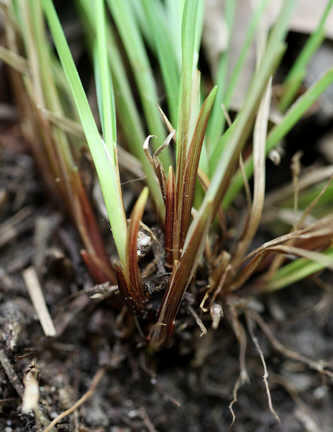
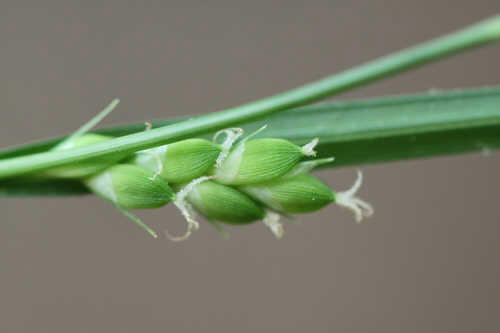
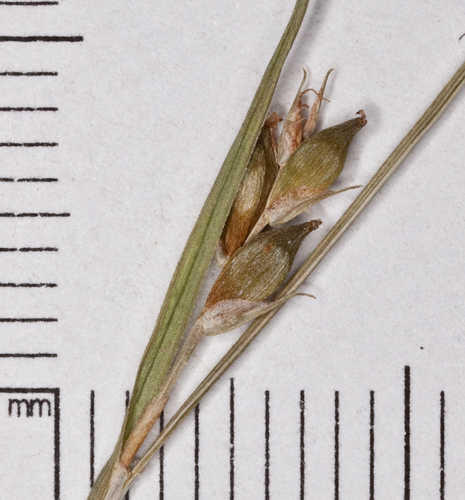
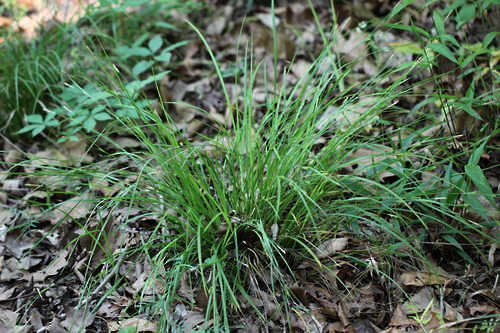
Perennial, grass-like herb forming dense clumps of several plants connected by very short rhizomes. Vegetative stems are 11 - 19 inches (28 - 49 cm) tall, 0.5 - 1.3 times as tall as the flowering stems. Flowering stems are 9.5 - 21 inches (24 - 53 cm) tall, three-angled in cross-section, leafy. Both flowering and vegetative stems are purple-red at the base for 2 - 3.2 inches (4.8 - 8.1 cm) above the ground. The leaves are less than 0.2 inch (4 mm) wide, the uppermost leaves are short, less than 4.3 inches (11 cm) long, lower leaves are longer, the blades and sheaths are uniformly green, and the blades are M-shaped in cross section. Each flowering stem has 4 - 5 widely separated (sometimes overlapping) spikes in the upper ¾ of the stem. A single staminate (male, pollen-bearing) spike up to 1.3 inches (3.2 cm) long is held erect at the top of the flowering stem on a slender stalk 0.2 - 4 inches long (3.4 - 104 mm) long. Three or four pistillate (female, fruit-bearing) spikes are held further down along the stem, each containing 3 - 12, heavily veined, narrowly oval or oblong, overlapping sacs (perigynia), up to 4.9 mm long, each tightly enclosing a tiny (less than 3.5 mm long), 3-sided fruit (an achene). Beneath each perigynium there is a pale, papery, oval scale, shorter than the perigynium and with a midvein extending into a bristle at the tip.
Distinguishing among species of Carex usually requires some technical expertise and at least 10x magnification. Carex thornei can be fairly well distinguished in the field by a combination of these features: the uppermost leaves are short, less than 4.3 inches (11 cm) long; the staminate spike is supported by a long stalk, up to 4 inches (10.4 cm) long, and the perigynia are essentially beakless and are longer relative to width (i.e. narrower) than in most other Carex. Identification should be confirmed with reference to a technical manual or herbarium specimens.
Forty-five species of Carex are rare in Georgia, see: https://georgiabiodiversity.org/portal/element_lists?group=plant
Detailed information about these 10 rare Carex species is provided on this website:
Acid-Loving Sedge (C. acidicola): https://georgiabiodiversity.org/portal/profile?group=plants&es_id=34933
Baltzell's Sedge (C. baltzellii): https://georgiabiodiversity.org/portal/profile?group=plants&es_id=15974
Granite Dome Sedge (C. biltmoreana): https://georgiabiodiversity.org/portal/profile?group=plants&es_id=19146
Lime-fleeing Sedge (C. calcifugens): https://georgiabiodiversity.org/portal/profile?group=plants&es_id=33655
Velvet Sedge (C. dasycarpa): https://georgiabiodiversity.org/portal/profile?group=plants&es_id=15939
Cypress-knee Sedge (C. decomposita): https://georgiabiodiversity.org/portal/profile?group=plants&es_id=21206
Meager Sedge (C. exilis): https://georgiabiodiversity.org/portal/profile?group=plants&es_id=34936
Wretched Sedge (C. misera): https://georgiabiodiversity.org/portal/profile?group=plants&es_id=16740
Radford’s Sedge (C. radfordii): https://georgiabiodiversity.org/portal/profile?group=plants&es_id=15374
Roan Mountain Sedge (C. roanensis): https://georgiabiodiversity.org/portal/profile?group=plants&es_id=21034
Thorne's Sedge (C. thornei): https://georgiabiodiversity.org/portal/profile?group=plants&es_id=34939
Moist deciduous forests, in sandy loam soils, usually on upper portions of flood plains and adjacent slopes.
Carex thornii is a perennial herb that reproduces by seed. It flowers and sets fruit in the spring. Like most sedges, it is wind-pollinated. Its small seeds are eaten and dispersed by birds and other small vertebrates.
As with all Carex, mature fruits are important to the identification of Carex thornei, which flowers and fruits in the spring. Magnification of 10x or higher is necessary to see features of the fruits. Carex thornei frequently grows with Carex abscondita, Carex basiantha, Redbud (Cercis canadensis), Beech (Fagus grandifolia), and Wild Ginger (Hexastylis arifolia).
Carex thornei occurs only in the Apalachicola, Chattahoochee, and Flint river watersheds of Georgia, Alabama, and the Florida panhandle.
Carex thornei is threatened by commercial and residential development, logging, conversion of habitat to pine plantations, and recreational vehicle traffic. As an inconspicuous sedge, it is likely to be overlooked or misidentified during surveys, leading to unintentional destruction.
| Threat 1 | Threat 2 | Threat 3 | |
|---|---|---|---|
| General Threat | Pollution | Climate change & severe weather | None |
| Specific Threat | None | None | None |
Carex thornei is ranked S2? by the Georgia Department of Natural Resources, indicating that it is imperiled in the state but that there is not sufficient information about the species to assign a definitive rank. It has been documented from nine sites in Georgia, although only three of these have been confirmed in the last 20 years. Three populations occur on public and/or conservation land.
Protect mature hardwood forests and hammocks from conversion to commercial and residential development and pine plantations. Protect populations from recreational vehicle traffic. Include species as targets during surveys of mature upland and bottomland forests.
Ball, P.W. and A.A. Reznicek. 2003. Species account for Carex thornei. Flora of North America North of Mexico, vol. 23. Accessed 7 August 2019. http://www.efloras.org/florataxon.aspx?flora_id=1&taxon_id=242101826
Naczi, R.F.C., C.T. Bryson, and T.S. Cochrane. 2002. Seven new species and one new combination in Carex (Cyperaceae) from North America. Novon 12: 508-532. https://www.jstor.org/stable/pdf/3393132.pdf?refreqid=excelsior%3A12fa0d2f645ce64d889366aaf2d83c2d
NatureServe. 2019. Species account for Carex thornei. NatureServe Explorer: an online encyclopedia of life, Version 7.1. NatureServe, Arlington, Virginia. Accessed 8 June 2019. http://explorer.natureserve.org/servlet/NatureServe?searchName=Carex+thornei
SERNEC. 2019. Herbarium records for Carex thornei. Southeast Regional Network of Expertise and Collections. Accessed 7 August 2019. http://sernecportal.org/portal/
Weakley, A.S. 2015. Flora of the southern and mid-Atlantic States. University of North Carolina Herbarium, University of North Carolina, Chapel Hill. http://www.herbarium.unc.edu/flora.htm
Linda G. Chafin
Linda G. Chafin, 7 August 2019: original account