

Loading profile. Please wait . . .
Ophiogomphus australis Carle, 1992
Southern Snaketail


Federal Protection: No US federal protection
State Protection: No Georgia state protection
Global Rank: G1G2
State Rank: S1
Element Locations Tracked in Biotics: Yes
SWAP 2015 Species of Greatest Conservation Need (SGCN): Yes
SWAP 2025 Species of Greatest Conservation Need (SGCN): Yes
2025 SGCN Priority Tier: Highest Conservation Concern
Element Occurrences (EOs) in Georgia: 1
Habitat Summary for element in Georgia: Small streams in woodland with some gravelly substrate
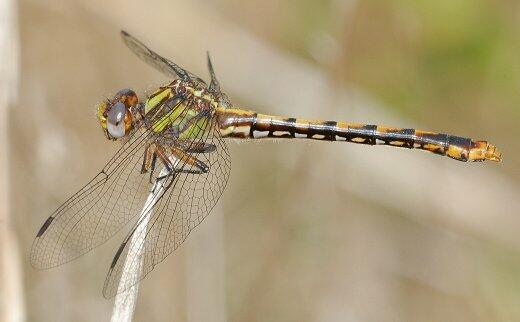
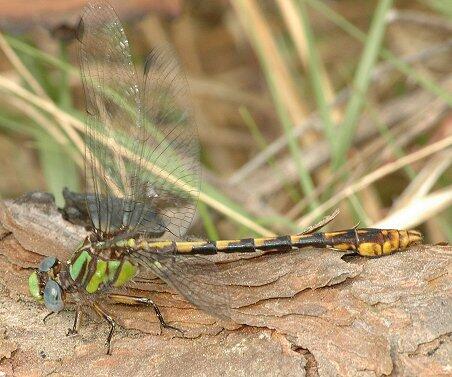
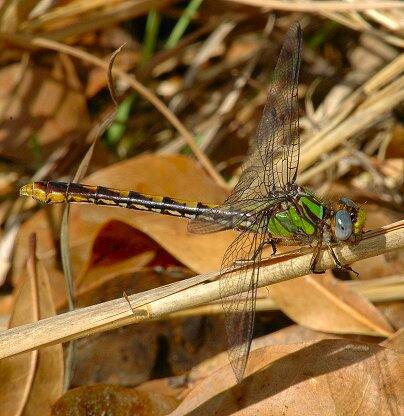
A medium-sized bright green dragonfly that averages about 45mm (1.8 in) in length. The thorax is bright green, with split mid-dorsal, two shoulder, and two lateral brown stripes. The anterior lateral stripe is variable, and sometimes broken; the posterior stripe is much thicker. The eyes are blue-gray to blue, and the face is yellow-green. The legs are mostly black, with brown thighs. The abdomen is very dark brown, with yellow dorsal markings on all segments that shorten posteriorly and are usually only represented as a spot on segment 9. Lateral yellow or pale markings of males are present on most segments. The Female is similar but the abdomen is thicker, with yellow lateral markings on every segment. Club virtually absent in females.
This is the only snaketail that occurs in its very southern range. Somewhat similar to the Eastern Ringtail but that species only occurs on much larger streams and rivers and has a very different abdominal pattern of black and white rings.
Small forested streams with some component of gravel in the sediment, like most snaketails.
Adults eat almost any insect prey they can catch on the wing. Larvae eat a variety of aquatic invertebrates.
The larvae spend their two-year lives in the detritus at the bottom of pools and eddies in the stream, and then emerge in late March. Adults are only on the wing from late March to early April, this very short flight season plus the rarity of their habitat makes them very hard to find. Males patrol over riffles in the stream, especially those on the edge or out of the forest, and females usually only come to the water to oviposit. There is a slight increase in visits to the breeding habitat in late afternoon by both sexes.
Surveys are urgently needed elsewhere in southwestern Georgia to see if there is any more suitable habitat for this rare species, if there is any remaining.
Core of this species’ tiny range is along the southern border of Mississippi and Louisiana. Also known from several widely scattered locations east of core range: Baldwin, Clarke and Dallas Counties (southern Alabama), Escambia County (far western panhandle Florida), and Early County (southwestern Georgia). The range of this species was probably much larger pre-settlement, but habitat loss due to farming and development have reduced its range to just a few sites.
The primary threat to this species is habitat alteration associated with agricultural practices and commercial and residential development in the southwest Georgia. Failure to follow agricultural best-management practices results in sedimentation and bank destabilization and potential degradation of water quality from pesticide and fertilizer runoff. The two known streams are in the same watershed and are also vulnerable to water table losses.
| Threat 1 | Threat 2 | Threat 3 | |
|---|---|---|---|
| General Threat | Natural system modifications | Pollution | None |
| Specific Threat | Dams & water management/use | None | None |
S1 for Georgia
Incentive programs to help farmers implement best-management practices could improve instream habitat by decreasing sedimentation and runoff and increasing riparian forest cover. Forestry operations should follow best management practices (BMPs) for water quality. Conservation groups should work cooperatively with developers and local governments to minimize the impacts of new home construction and commercial development. There is an urgent need for additional surveys to document new populations and for periodic monitoring of known populations.
Needham, J.G., M.J. Westfall, Jr., and M.L. May. 2014. Dragonflies of North America, 3rd Edition. Scientific Publishers, Gainesville, FL. 656 pp.
Odonata Central Website https://www.odonatacentral.org/app/#/data/records/?filterqs=%7Cexcludeinat%7Ctaxons%3A46452 (Accessed 26 Dec 2020)
Paulson, D. 2011. Dragonflies and Damselflies of the East. Princeton University Press, Princeton NJ. 538 pp.
Giff Beaton
22 December 2021